



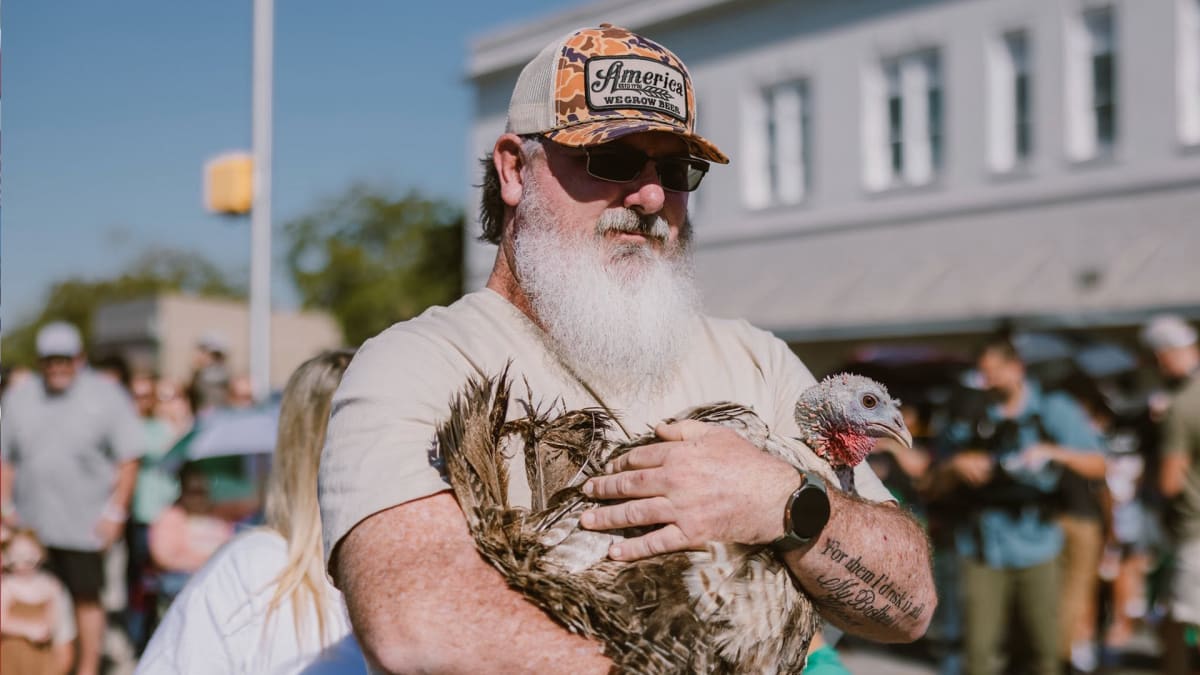
Ready. Set. Gobble!
Some town rivalries require helmets and marching bands. Cuero settles one of its oldest by placing a turkey on Main Street, starting a stopwatch and trusting civic pride to handle whatever happens next.
The Cuero Turkeyfest returns October 9 through 11, bringing live music, barbecue, a carnival and assorted community events to town. Yet the weekend’s defining moment remains Saturday morning, when two birds inherit the reputations of two states.
At the Great Gobbler Gallop, Cuero’s Ruby Begonia races Paycheck of Worthington, Minnesota. The sprint begins at Main Street and Esplanade before the Turkeyfest parade, with the title of Turkey Capital of the World hanging on the combined results from races in both communities.
The winner claims the Traveling Turkey Trophy of Tumultuous Triumph. The loser receives the Circulating Consolation Cup of Consummate Commiseration, a name long enough to make defeat feel like an administrative procedure.
Before Ruby, Thousands of Turkeys
The race’s comedy rests on serious local history. Cuero’s turkey industry began expanding in the early 1900s, after a processing plant opened near the railroad in 1908. Without modern livestock trucks, area farmers drove their flocks into town on foot.
Thousands of birds once moved through Cuero’s streets on their way to processing. The first Turkey Trot, held in 1912, reportedly drew an estimated 30,000 people to watch more than 18,000 turkeys pass down Main Street. Corn scattered along the route helped keep traffic moving, a municipal strategy unlikely to appear in today’s transportation manual.
The turkey business eventually shifted away, and the old Turkey Trot ended in 1972. One year later, Cuero created Turkeyfest to preserve the agricultural story. Worthington had its own turkey heritage and its own claim to the capital title, so newspaper editors arranged a race. Small-town diplomacy has rarely been more efficient.
Why the Tradition Still Runs
Turkeyfest remains a nonprofit, community-run organization whose original purpose included creating fundraising opportunities for local civic groups. Volunteers plan, build and dismantle the celebration, while families return for the parade, cook-off, music and annual reunion.
That structure explains why the Gallop has survived. The bird race supplies the spectacle, but the tradition gives Cuero a common story, one peculiar enough to belong nowhere else. Plenty of towns can stage a festival. Only Cuero can send Ruby Begonia toward glory while an entire Main Street checks its watch.
Find more hometown celebrations in the Guide to Texas festivals directory: https://www.guidetotx.com/festivals
